Sex Offenders listed in the Greenville County database can be viewed instantly through the official sex offender registry at https://gcso.org/. A simple sex offender lookup shows each registered individual’s name, offense type, and current address on the sex offender map, helping neighbors gauge local safety. The portal also supplies sex offender information such as registration dates and compliance status, all tied to the 4 McGee Street office serving the community.
Residents seeking a thorough sex offender background check can call (864) 271-5210 during office hours, Monday through Friday, 8:30 AM‑5:00 PM. The agency ensures sex offender compliance verification and enforces residency restrictions that limit where offenders may live. Updated sex offender community notification alerts reflect risk or tier classifications, while the latest sex offender law and sentencing guidelines guide enforcement. Support groups and rehabilitation programs are listed to aid reentry challenges and public safety.
How to Search Sex Offenders
Search the Greenville County sex offender registry through the Greenville County Sheriff’s Office when you need to check a public registration record. The portal provides a sex offender lookup with name and location filters for records tied to Greenville County. You can also access jail roster to review official records. A registry listing can confirm certain legal details, yet it does not describe current conduct or replace a court record. Use official fields, dates, and agency confirmation before acting on a search result.
Official Search Portal: https://gcso.org/
Steps to Search
- Open the Greenville County Sheriff’s Office portal in a current browser. Find the link for sex offender records, registry search, or public records. Avoid third-party pages that copy sheriff’s office listings or charge for a search.
- Enter the person’s legal name in the sex offender search fields. Add a middle name, suffix, former name, or alias only when a court or official record provides it. A partial name can create several people with similar identities.
- Add location filters when the form offers them. Search by city, county, or ZIP code, and use both Greenville and the correct ZIP code when that helps narrow the results. A surname alone may return people who have no connection to a particular address.
- Submit the search and review each matching row. The public display may contain a photo, names or aliases, a registered address, the conviction or legal adjudication, registration dates, and a compliance or removal status. Exact fields depend on the portal version and the source that supplied the record.
- Open the matching listing and compare the available identity fields. Do not rely on a photo or name alone because common names and aliases can produce a false match. Check the address, offense category, and registration dates as well.
- Use the sex offender map to understand the general area shown by the registry. A map marker supports the official address on file, but it does not track the person in real time or prove that the person is at that location when the map opens.
- Record the source and the date of your search. If a field appears wrong, contact the Greenville County Sheriff’s Office with the listing name and disputed field. Do not confront the person or publish an unverified accusation based on a name match.
Sex Offender Registration Requirements
South Carolina registration duties come from Title 16, Chapter 21, Article 4 of the state code, especially Sections 16-21-220 through 16-21-235. A qualifying conviction or court finding creates a duty that is separate from the court sentence. Local chiefs of police maintain area records, while the South Carolina Department of Corrections operates the central registry. The deadlines described below reflect the state code and agency process in place on October 23, 2026, and a court order may set extra conditions.
Who Must Register
South Carolina law applies to three main legal triggers:
- A conviction for an offense defined as a sex offense. Major categories include criminal sexual conduct in the first, second, and third degree, criminal sexual conduct with a minor, and sexual battery, including the aggravated form of that offense.
- A court adjudication as a sexually violent predator under Chapter 44. This is a legal finding made through a statutory evaluation and court process, not a label created by a public search.
- A qualifying civil commitment under S.C. Code Section 44-37-100, which places a person under a court-ordered commitment after the required court process.
An arrest or pending charge does not carry the same registration effect as a final qualifying conviction or adjudication. The statutory definition reaches certain other offenses as well, so the charge, final disposition, and any later court action must be checked before a person’s duty is decided.
Registration Deadlines
Section 16-21-230 sets the baseline filing, update, and verification periods. These dates apply to the legal registration process even when the public portal shows no immediate change.
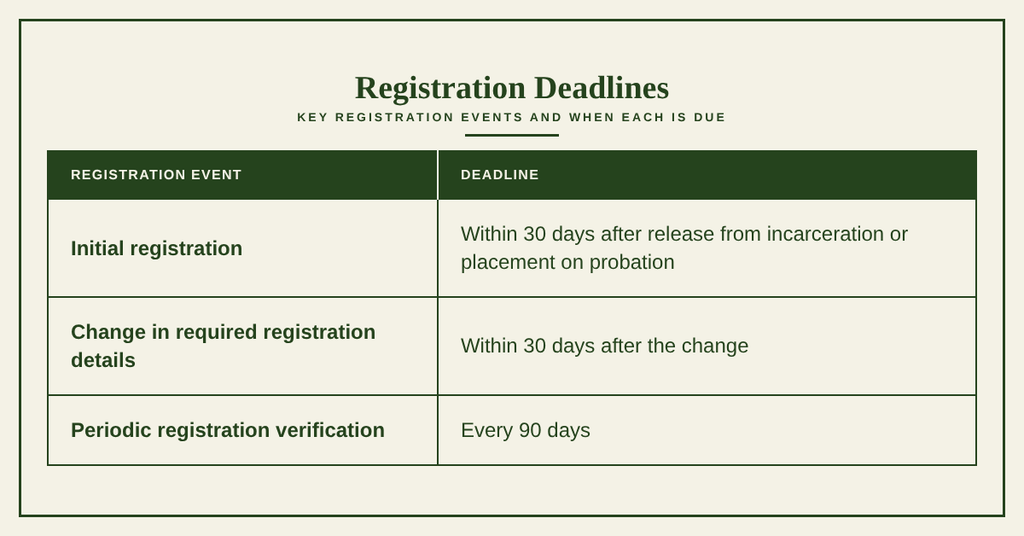
A person still in custody may receive registration instructions from the Department of Corrections or the supervising agency. Missing a filing date can lead to an investigation or criminal charge, so a person who is unsure about the deadline should contact the local chief of police before the period passes.
Required Registration Details
The full registration record contains more than the fields shown in a public search. Required categories include:
- Identity details, such as legal names, aliases, date of birth, race, sex, height, weight, eye and hair color, scars, and tattoos.
- Government identifiers, such as a Social Security number and driver’s license number.
- Residence details, including a home address, mailing address, and work or school address when the form requests it.
- Travel and vehicle details, including vehicle identification, plate data, and travel-document data.
- Electronic identifiers, including email addresses and social-network or messaging names used to contact minors.
Public search pages normally show only a subset of the full record. A complete registration file remains with the agencies responsible for verification and should not be copied onto a public webpage or sent through an unsecure message.
Address Reporting Requirements
The registration follows the person’s county of residence, so a move can involve a different local police agency. A registrant must report a new home address and the effective date within 30 days of the move. Related updates may cover a mailing address, work or school location, and other required details. Until the change reaches the central registry, the old address or map marker may remain visible.
Registration Updates
Name changes, new aliases, address changes, updated work or school details, vehicle changes, and changed electronic identifiers must reach the responsible agency within the required period. The person should keep a dated copy of each submission and request the next verification date. Completion of court-ordered treatment requirements, rehabilitation programs, or participation in support groups does not end registration by itself. Such programs may support public safety and reentry challenges, yet the registry and supervising agencies make separate decisions.
Duration of Registration
Section 16-21-225 sets two main registration periods based on the qualifying conviction or adjudication.
The registration period is separate from incarceration, fines, probation, and other sentencing rules. A court order can affect legal status, so only the court and the responsible registry agency can confirm the exact end date for a particular person.
Public Registry Classification
Registry labels condense a legal case into fields designed for matching and public notification. They do not contain every filed charge, dismissed allegation, defense, plea, or present circumstance. Reading each label in its legal context prevents a search result from creating a false conclusion about a person.
Offense Classification
The offense field identifies the conviction or legal adjudication that created the registration duty. It does not list every charge ever filed against the person, and it does not show allegations that were dismissed. A charge, plea agreement, conviction, and sentence are separate parts of a case. The court docket provides the clearest record of those events.
Risk or Tier Classification
A tier label, risk category, or offense classification must be read within the system that created it. South Carolina’s sexually violent predator status is a legal adjudication based on Chapter 44 procedures, not a live danger score produced by the public map. A sex offender risk assessment used by a court, parole board, or correctional agency may consider behavior, treatment, supervision, and other case details that the public registry does not show.
Registration Level
The clearest public level is the statutory registration period: life or 25 years. Some records also carry a compliance, noncompliance, or removal status. A level or status answers an administrative question about registration. It does not show that a new offense occurred or that the person failed to follow every condition of supervision.
Classification Changes
An appeal, reversed conviction, expungement, new court order, or change in commitment status can affect registry records. A sex offender expungement request does not guarantee immediate removal from the public registry. The court order must reach the Department of Corrections and local agency, and the central data feed must update. A defense lawyer can review the case record and explain whether a legal change has taken effect.
Multiple Qualifying Offenses
A person may have more than one qualifying conviction or adjudication. One listing may contain several offenses, or separate rows may appear because of aliases, suffixes, or different jurisdictions. The number of rows does not measure current danger. Use the court record to distinguish separate cases and confirm which legal outcomes placed the person under registration.
Sex Offender Residence Information
Residence data lets residents find relevant records and check whether address updates have reached the system. The address on file is administrative data, not live tracking. It can change, lag behind a move, or remain visible until the next registry update.
Registered Residence
The registered residence may appear with a city, ZIP code, and map marker. South Carolina law also limits where a registrant may live. Section 16-21-225 bars covered registrants from residing within 1,000 feet of a school, childcare facility, or playground and from loitering around those sites. It also restricts a registrant from occupying a residence where a child under 16 lives, subject to statutory exceptions. Local zoning rules may place stricter limits on certain locations.
Address Changes
A registrant moving to another home must report the change within 30 days. The filing may also update a mailing address, work or school location, or related registration fields. The public map can retain an old marker until the responsible agency receives and processes the filing, so the displayed residence may not equal the current legal address.
City and ZIP Code
City and ZIP code filters help separate people with common names. Searchers should check both fields because a ZIP code may cover several municipalities, and one person may use a different mailing address. Individuals can also check divorce decree to verify relevant details. A sheriff’s office address identifies the agency, not the residence of every person connected with the office. A map result near the agency does not prove that a registrant lives there.
Geographic Registry Searches
South Carolina permits registry searches by name, city, county, or ZIP code. Begin with the Greenville County portal for a local search, then use the central state registry if a person may have moved elsewhere in South Carolina. Geographic filters work best with a legal name. Searching a street address alone can miss a record when the address is spelled differently, recently changed, or not shown in the public display.
Residence Information Limitations
An address can be wrong, outdated, restricted under applicable records rules, or too broad to show a precise location. The person may have moved before the agency processed the last update. The map provides a visual reference, not proof of presence at a stated time. Do not visit an address solely because it appears in a registry. Verify the record with the sheriff’s office and report safety concerns through proper channels.
Registry Compliance and Status
Registry status shows whether registration duties are active and current under the agency’s records. It does not provide a complete account of supervision, treatment, behavior, or present risk. Reading status correctly helps residents avoid both false alarms and missed signs of a real record problem.
Active Registration
An active registration means the person remains subject to a registration duty and the record appears in the public system. It does not mean a new offense occurred, a new arrest was made, or the person has failed to comply. It also does not show that the person is near the location used for the search.
Registration Compliance
A compliant status means required updates and periodic verifications have been completed as of the agency’s latest check. A missing badge or delayed update can leave the status unclear. Court-ordered GPS, electronic monitoring, or sex offender tracking technology is a separate part of supervision and often does not appear on the public registry. A public status cannot confirm whether such a device is active.
Failure to Register
Failure to register, renew, verify, or report a required change can be a criminal offense and may affect supervision. A search result cannot independently prove that a violation occurred because the agency may still be reviewing the filing history. The official case record and the responsible police agency control that conclusion.
Noncompliant Registration Status
A noncompliant label means the agency has flagged an unmet registration duty or is still resolving a verification issue. The cause may involve a missed verification, an address update, a document sent to the wrong agency, or another administrative matter. Contact the sheriff’s office for the current case status. Public labels can be wrong during an update, so spreading the label without agency confirmation creates an avoidable risk.
Registration Termination
Termination ends an active registration duty when the statutory period expires or a court or agency action ends the obligation. The person must complete the required process before the central record changes, and the public feed can take time to update. Termination is separate from expungement, because the underlying court record may remain even after the registry obligation ends.
Removal From the Registry
Removal closes the public listing after the applicable term, order, or agency process is complete. Verify the removal date and current status rather than assuming that a person has disappeared because of a search error. Removal does not erase every arrest, court, or correction record. A defense attorney can examine a disputed removal or expungement issue and distinguish the court outcome from the registry update.
Using the Public Sex Offender Registry
Official sources serve different purposes. The Greenville County portal supports local searches, the state registry supports statewide searches, and court records answer questions about charges, sentences, and orders. Choosing the right source prevents a limited registry search from being treated as a complete criminal-history search.
Online Registry Access
Use the official Greenville County portal shown at the start of this page for local online searches. The South Carolina Department of Corrections operates the central registry for statewide use and status checks. Paid search pages and people-search sites may copy old records, combine unrelated names, or display an outdated address. The official portal remains the best starting point for a current registry search.
Publicly Displayed Details
Depending on the record and current portal design, a public listing may show a photo, legal names and aliases, physical descriptors, conviction or adjudication, registration dates, residence, city, ZIP code, map location, and compliance or removal status. Sex offender community notification by a police agency may also provide local alerts under Section 16-21-240. A community notice is not the same as an emergency alert, and a registry row does not announce a recent offense.
Official Registry Sources
Historical Registry Information
The current public search is a snapshot, not a full historical archive. A current row may show a recent address, while an older address may appear in a prior agency record. For historical registry snapshots, submit a written public-records request to the records custodian and identify the person, date range, and requested record type. Retention rules and redaction may apply. Court dockets provide the better source for the history of charges and court actions.
Official Registry Record Requests
Send written requests for older records, agency correspondence, or bulk registry data to the office that holds the record. Include the full name, known aliases, relevant dates, and the exact type of record needed. The agency may require identity verification before releasing a record and will state any applicable fee or copying charge. Do not send a full government identifier or unnecessary personal data through an unsecured message.
Registry Record Accuracy
Accuracy checks matter because a stale address can point to the wrong place, and a common name can place two people on the same row. Official confirmation reduces false matches and prevents outdated public data from being treated as current.
Confirming a Registry Listing
Confirm a listing through the official portal and compare several available identity fields, such as the full name, aliases, physical description, offense category, and registration period. A sex offender background check based only on the registry is incomplete because the registry is not a full criminal-history record. A lawful background check may require consent, a court order, or a permitted consumer report.
Checking Current Registration Status
Look for active, compliance, noncompliance, or removal language when the portal provides it. Compare the displayed date with your search date and avoid treating an old map image as current. If the status has practical importance, ask the sheriff’s office to confirm it. A blank status field may mean that the record is awaiting an update rather than that no duty exists.
Verifying Address Information
Compare the city, ZIP code, map location, and last update date for a suspected address error. A recent filing may not yet have reached the central registry, and a registrant may have changed addresses without filing the required update. Ask the agency to compare the public row with its source record. Avoid visiting or contacting the listed resident during the verification process.
Identifying Duplicate Listings
Duplicate-looking results can come from a former name, suffix, middle name, alias, or a record created in another county. Compare the available fields before treating two rows as the same person. Some entries may represent one person recorded in separate source systems. The sheriff’s office or the central registry can determine whether a correction or consolidation is needed.
Reporting Incorrect Registry Details
Report an error through the official sheriff’s office channel. Provide the listing name, the incorrect field, the correct value, and the source that supports the correction, such as a court docket or agency notice. You can also consult genealogy records to locate official filings. A screenshot and access date can help the agency locate the row. Keep the report factual, omit unproven accusations, and do not post the person’s details while the agency reviews the claim.
Sex Offender Registry Privacy and Limitations
Public registry access has legal limits because the system holds personal and case-related data. It is a limited public record built for identification and public-safety purposes, not a complete profile of a person’s life or character.
Public Registry Details
The public display contains only fields authorized for public matching and notification. A request for more data does not make withheld fields public. The authorized set can change as state rules and portal design change, so users should judge each record by the fields actually displayed and the date shown. The public record should not be merged with private social-media details or unrelated personal data.
Details Withheld From Public Search
A public search normally does not show full government identifiers, the complete police case file, victim details, or a live monitoring feed. Some address details may also be limited under applicable records rules. The law-enforcement registration file contains more data than the public page, but that does not create a right to publish the full file. Sensitive fields should remain with the agency that holds them.
Protected Personal Information
Victim identities, juvenile records, confidential medical or treatment records, sealed court papers, and witness details can receive separate legal protection. A person making a record request should state the lawful purpose and accept any required redactions. Publishing protected material can cause civil, criminal, or professional consequences even when the material came from another court record.
Registry Data Limitations
The registry does not contain a complete case history, a real-time address feed, or every condition of supervision. An address may lag, a status may be delayed, and a photo may be old. The map does not show GPS monitoring, treatment attendance, or a current danger score. Sex offender prevention decisions based on the registry should account for these limits and use current agency confirmation.
Legal Restrictions on Registry Use
South Carolina law addresses public dissemination and misuse of registry records in Sections 16-21-240 and 16-21-250. Using registry data to harass, intimidate, or defame a person can lead to criminal penalties. Do not use a registry row as a stand-alone reason to deny housing, employment, credit, or services. Those decisions must follow fair housing, employment, consumer-reporting, and privacy laws. Public safety efforts should rely on verified records and police channels rather than public confrontation.
Search Problems
Most failed or confusing registry searches trace back to spelling, aliases, recent updates, records outside Greenville County, or a difference between what the law requires and what the portal displays. Work through those points before drawing a conclusion from an empty or crowded result page.
Person Not Found
A missing person may have a different legal name, an alias, a record in another county, a completed registration period, or no registration duty. A recent removal can also be hidden by a delayed feed. Search statewide and try spelling variants supported by official records. Absence from the registry does not prove that a person has no conviction or legal history.
Multiple Matching Listings
Several rows can share a common name, middle name, suffix, or alias. Review the residence, offense category, registration date, and photo before comparing the people. Rows from different counties may also belong to the same person. Ask the official registry to resolve a true duplicate instead of merging records yourself.
Address Search Produces No Results
An address search may fail because of a missing space, street-type abbreviation, old municipality name, incorrect ZIP code, or a recent move. The registry may also not display every protected or restricted address. Search by legal name through both the local and statewide sources before asking the agency to check an exact street record.
Recently Updated Listing
A recently changed record may still show an older map marker or cached search result. Refresh the page, note the update date, and compare the text address with the map. Data often moves from the local agency to the central registry in stages. The sheriff’s office can confirm whether the change concerns the address, compliance status, or another field.
Incomplete Registry Entry
A blank field may mean that the source record has not synced, the portal omits that category, or a legal restriction limits display. Do not guess the missing value or treat it as evidence that no duty exists. Request confirmation of the named fields from the records custodian and keep the inquiry tied to the specific listing.
Incorrect Search Details
Correct spelling errors, wrong name order, incorrect ZIP codes, and missing aliases before treating a result as false. If the official record still contains the same error, report it with supporting court or agency documents. A legal dispute over registration status should be handled through the court and the responsible agency, with a defense attorney providing case-specific advice.
Contact Details
For questions about a Greenville County registry record, contact the Greenville County Sheriff’s Office at 4 McGee Street, Greenville, SC 29601. The phone number is (864) 271-5210, and office hours are Monday through Friday, 8:30 AM–5:00 PM. The street address is an agency office, not a registered residence. Use the official search portal at the start of this page for routine lookups, and call with the listing name, search date, and disputed field for a record check.
Frequently Asked Questions
Below are common questions about locating and understanding sex offender information in Greenville, South Carolina.
How can I search the Greenville sex offender map?
Visit the Greenville County Sheriff’s Office portal at https://gcso.org/. The site offers a searchable map where you can enter a name, address, or ZIP code. Results show registered offenders within the selected area, including their name, offense type, and last known address. Use the map filters to narrow the view by distance or offense category. The information updates regularly, but verify details with the office if you plan to take action based on the data.
What information appears in a sex offender lookup?
A typical lookup lists the offender’s full name, birth date, photograph, and physical description. It also includes the offense classification, date of conviction, and the address where the offender must reside. Some entries note whether the individual is a repeat offender or under supervision. The record does not contain current behavior or pending legal matters. For the most accurate picture, compare the online entry with the paper file available at the sheriff’s office.
Do sex offenders have residency restrictions?
Yes. State law requires many offenders to stay a minimum distance away from schools, parks, and day‑care centers. The exact distance varies by offense level, often ranging from 500 to 1,000 feet. Local ordinances may add extra limits around churches or government buildings. Violating these rules can lead to fines or arrest. If you need specific boundaries for a property, contact the Greenville County Sheriff’s Office for a detailed map.
How often must a sex offender update their registration?
Registrants must confirm or update their details every year on the anniversary of their initial filing. The sheriff’s office sends a reminder notice before the deadline. Changes in address, employment, or name require an immediate update, typically within 30 days. Failure to report changes can result in criminal penalties. Keep a copy of the confirmation letter as proof of compliance.
Where can I request a sex offender background check?
You can request a background check through the Greenville County Sheriff’s Office during business hours, Monday through Friday, 8:30 AM to 5:00 PM. Call (864) 271‑5210 to schedule an appointment or walk in with a valid ID. The office processes requests on the spot and provides a printed report. Fees may apply, and the check covers any offenders listed in the county’s public registry.